Autoencoders to Improve Brain-Computer Interfaces
Mind-Powered Technology
When most people want to reach out and grab a cup of coffee, they’re able to think about it and do it nearly simultaneously. Someone with paralysis can think about reaching out and grabbing the cup, but because of the disconnect between their brain and body, they can't.

Chethan Pandarinath, PhD
There are assistive technologies to address this problem, including tiny, brain-embedded sensors called brain-computer interfaces (BCIs), which work by reading the electrical signals in a patient’s brain and translating their desire to speak or move into action. But these BCIs have limits.
Chethan Pandarinath, PhD, Assistant Professor of Biomedical Engineering at Emory University, and his team are making better BCIs with autoencoders — types of neural network trained to discover hidden patterns in unlabeled data — bringing the technology one step closer to restoring the abilities of people with paralysis.
Converting Electrical Activity into Action
When the brain gives the body a command, it does so by creating electrical activity in the brain. For people with paralysis, BCIs — tiny sensors implanted into the brain — can act as a liaison between those electrical signals and turn them into physical responses. BCIs are an empowering tool that turn thoughts into action.
But how do the BCIs know which electrical impulses correspond to which action? The process of figuring out what the electrical activity means is called "decoding."
Decoding the Brain
Decoding brain signals is a complicated process.
A single, small action can involve hundreds to thousands of neurons. Every time a neuron communicates with another neuron, there's a little voltage blip called an action potential, or spike. These spikes are the signals that the BCIs must detect and decode. There are so many spikes for any given action, and they all have to be decoded into a form that the BCI can understand.
“What we show is that the spiking activity itself is highly variable and very challenging to decode,” explained Pandarinath. "If we use a special type of neural network formulation in an autoencoder, we can train neural networks to essentially remove the noise from the spiking activity, making it much easier to decode.”
Latent Factor Analysis via Dynamical System (LFADS) is a sequential autoencoder developed by Pandarinath’s lab group, the Systems Neural Engineering Laboratory, to aid the decoding process.
LFADS enables deep learning by extracting information about which behavioral variables affect certain areas of the brain in response to neural activity. It then takes this information to infer which motions of the body are correlated with spiking neuron activity and firing rate, and combines data from non-overlapping recording sessions spanning months to improve its performance.
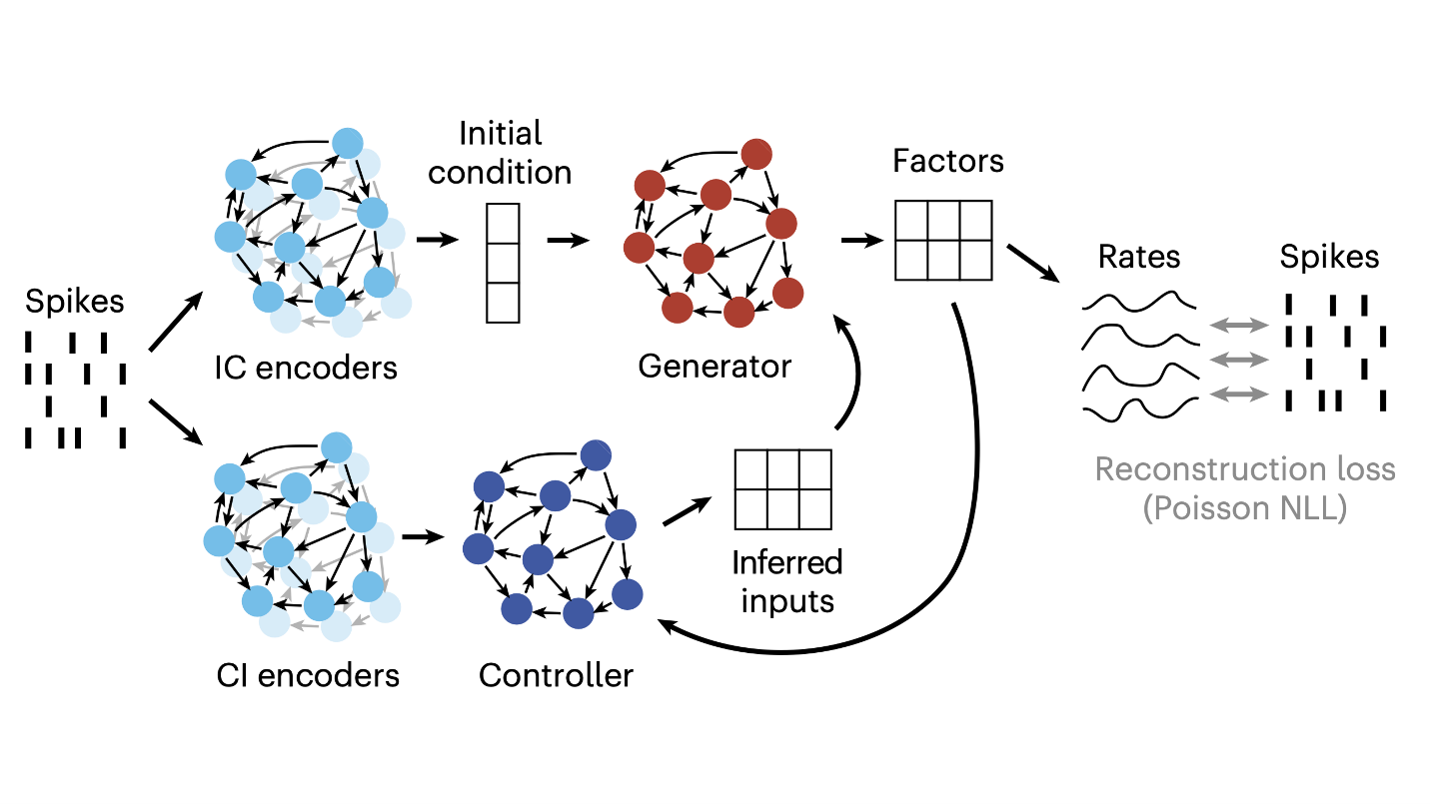
Latent factor analysis via dynamical systems, a deep learning method to infer latent dynamics from single-trial neural spiking data.
Chethan Pandarinath/Systems Neural Engineering Laboratory
Sorting Through the Noise
One of the key challenges of decoding brain activity is separating an action’s necessary signals from other spikes that don’t directly to relate to it — what the inventors call “noise.” But traditional neural network methods often overfit, meaning the computer learns “too well” and considers the noise to be essential signals for an action.
Pandarinath’s autoencoder is different: With a coordinated dropout-based network training method, it allows the BCI to take in the proper neural activity and produce the correct response, translating the spiking activity into the person’s intention with greater accuracy than prior technologies.
“We found [our training method] effectively eliminates some unique forms of overfitting. It is much easier to optimize neural networks on brain data, which is critical when you think about applying them to diverse datasets,” said Pandarinath.
Shweta Ghai, PhD, a senior licensing associate at the Emory University Office of Technology Transfer and case manager for this technology, agreed on its potential impact, adding, “Dr. Pandarinath’s research suggests that this technology has real-world applications. Additionally, the fact that this is a non-pharmacological neurostimulation technique with greater relevance for clinical use represents a hopeful path forward for patients with paralysis.”
Further Development and Applications
The autoencoder has demonstrated its efficacy in basic neuroscience, brain decoding, and stabilizing BCIs over months- to years-long timescales, and it has potential applications across many domains. The team published their findings in Nature and was granted a patent for this technology in 2025.
The neurotechnology space is booming with new start-ups working to develop implantable hardware to read out high-resolution brain activity. But, Pandarinath warns, as these ventures get more sophisticated, so will their technological needs.
“As these startups mature and begin to need new and better ways to decode the activity monitored from their new hardware, our technologies and algorithms will be exceptionally well-suited to solve some practical problems that they'll face,” said Pandarinath.
There are approximately 125,000 to 194,000 paraplegics in the US, and this technology is a huge step in helping those people, giving their brains a voice by quieting the noise.
— Jenna Woods
TechID: 18168
Learn more about this technology in the non-confidential summary.
Are you an industry partner looking to license this technology? Reach out directly at omarket@emory.edu.